I was looking at an old globe the other day—one of those textured ones where you can feel the mountain ranges if you run your fingers over them. My finger traced the line of the 49th parallel, moving north into that vast, expansive splash of pink that represents Canada. It made me wonder: how often do we look at a place on a map and think we know it, just because we recognize its shape?
We think of maple syrup. We think of snow. We think of polite people saying “sorry.” But when you actually step foot onto the soil, breathe the air of the boreal forest, or stand in the shadow of a skyscraper in Toronto, the reality is so much more complex and vibrant than the caricature.

For teenagers, Canada isn’t just a destination; it’s a mirror. It’s a place that challenges you to be bigger, to explore further, and to understand that the world is both incredibly vast and intimately connected. If you are thinking about joining a Teen Treks adventure, cycling through the mist of Niagara Falls or the historic streets of Quebec, you are signing up for more than a vacation. You are signing up for a lesson in scale, culture, and resilience.
Let’s take a journey through the facts—not just the ones you find in textbooks, but the ones that make you pause and ask, “I wonder what else I don’t know?”
The sheer scale of the place
We often talk about “big” as if it’s just a measurement, a number on a page. But have you ever stood on a coastline and felt like the ocean goes on forever? Canada is the second-largest country in the world by total area, right after Russia. It covers nearly 10 million square kilometers.

That number is hard to wrap your head around, isn’t it?
Imagine this: if you started walking along Canada’s coastline—which, by the way, is the longest in the world at over 202,000 kilometers—and you didn’t stop to sleep or eat, it would take you more than four years to finish. That’s the kind of vastness that makes your own worries feel small. When you are cycling through a province, you realize that you are just a tiny speck in a magnificent, sprawling landscape.
And it’s not just land. It’s water. Canada has more lakes than the rest of the world combined. Think about that for a second. More than every other country, added together. When you look out at a lake in Ontario or British Columbia, you are looking at a resource that defines the geography of an entire continent. It makes me wonder about our responsibility to protect these blue spaces, these reservoirs of life.
Join Us in Toronto!
A name rooted in community
Names have power. They tell us where we come from and what we value. The name “Canada” itself is a beautiful misunderstanding that speaks to the history of the land.

It likely comes from the Huron-Iroquois word kanata, which means “village” or “settlement.” In 1535, two Indigenous youths used the word to describe the village of Stadacona (near present-day Quebec City) to the explorer Jacques Cartier. Cartier, perhaps hearing what he wanted to hear or simply expanding the definition, used “Canada” to refer to the entire region.
I find it poetic that a country so massive is named “village.” It suggests that despite the physical distance between Vancouver and Halifax, there is an intention of community. It reminds us of the deep, foundational relationship Indigenous nations have with this land—a relationship that predates borders and maps.
As you cycle through these regions, you’ll see the interplay of history. You’ll see the British influence, symbolized by the fact that Canada is a constitutional monarchy (yes, King Charles III is the King of Canada). You’ll see the French heritage, particularly in Quebec, where the language and culture create a distinct, vibrant identity. Canada is officially bilingual, and its multiculturalism isn’t just a policy; it’s a way of life. Walking through a city like Toronto, you hear a symphony of languages. It makes you realize that being “Canadian” isn’t about fitting into one mold; it’s about bringing your own story to the collective village.
Where the wild things are
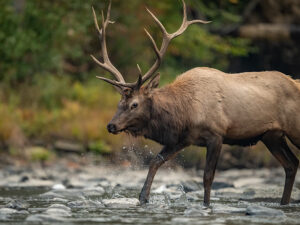
I remember the first time I saw a moose in the wild. It wasn’t majestic in the way a lion is majestic; it was prehistoric. It was huge, awkward, and undeniably powerful.

Canada has the largest moose population in the world. These giants roam the forests, symbols of the rugged wilderness. But they aren’t alone. The biodiversity here is staggering. From the polar bears in Churchill, Manitoba (the “Polar Bear Capital of the World“) to the grizzlies in the Rockies, the land is alive.
But there’s also room for mystery. Every culture has its legends, the stories we tell in the dark to make sense of the unknown. In Canada, specifically in Okanagan Lake, there is the legend of Ogopogo. It’s a lake monster, much like the Loch Ness Monster in Scotland. For centuries, the Indigenous Syilx people have spoken of a spirit in the lake. Whether you believe in a physical creature or not, the story itself connects us to the water and the respect we owe it. It makes you look at a calm lake surface a little differently, doesn’t it? It invites you to wonder what lies beneath.
The sweetness and the weirdness
Let’s talk about something we can all agree on: maple syrup.

Did you know that Canada produces approximately 71% of the world’s pure maple syrup? And of that, the vast majority comes from Quebec. It’s a labor of love, tapping the trees when the sap starts running in the spring. It’s a connection to the seasons. When you pour that syrup on your pancakes, you are tasting the Canadian climate.
But Canada is also home to some truly unique, almost strange facts.
Take the beaver dam, for instance. Beavers are the national animal (industrious, humble, persistent—good qualities, right?). In Wood Buffalo National Park, there is a beaver dam so large it can be seen from space. It’s about 850 meters long. It was built over generations of beaver families. It makes me think about legacy. What are we building that will last that long?

Then there’s the myth of Yonge Street. For a long time, people claimed it was the longest street in the world. While that title was taken away by the Guinness World Records in 1999 (it turns out Yonge Street and Highway 11 are distinct entities), the legend persists. It speaks to our desire to be part of something endless.
And we can’t forget sports. If you visit in the winter, you will see hockey rinks everywhere. It is the national winter sport, codified by the National Sports of Canada Act (yes, that’s a real law). But did you know that the national summer sport is Lacrosse? It has Indigenous origins and is a fast-paced, incredible game. It reminds us that play is a universal language.
If you find yourself on the east coast, at the Bay of Fundy, you will witness the highest tides on earth. The water can rise as high as a five-story building. Standing there, watching the ocean rush in, you feel the raw power of the moon and the earth. It’s a humbling reminder that nature is always in charge.
A mind at work
We often associate adventure with physical activity—cycling, hiking, climbing. But Canada is also a place of the mind.
It consistently ranks as one of the most educated countries in the world, with a high percentage of adults holding tertiary degrees. This emphasis on learning shows up in the innovation you see in the cities.

Speaking of innovation, did you know the telephone has deep Canadian roots? Alexander Graham Bell, while born in Scotland, spent significant time in Brantford, Ontario. It was at his family home there that the concept of the telephone was solidified, and where he made the first long-distance call to Paris, Ontario.
Communication. Connection. Community. These themes keep coming up, don’t they?
The view from the saddle
When you are on a bike, the world moves at a human speed. You don’t fly over the details; you ride through them.
If you join a Teen Treks summer bicycle tour, you might find yourself in the Canadian wonderland. The mountains in Canada don’t just look big; they feel ancient. The turquoise lakes, colored by glacial silt, look almost fake until you dip your hand in the freezing water.

Or perhaps you’ll be in Toronto. It’s the largest metropolis in Canada, a city of neighborhoods where you can eat food from any corner of the globe within a few blocks. It’s vibrant, busy, and exciting.
Then there is the history of Quebec and the thunder of Niagara Falls. These aren’t just postcards. They are places where history was made, where battles were fought, and where nature shows off.
Join Us in Vancouver!
The open road awaits
Why do we travel? Why do we leave the comfort of our homes to sleep in tents or cycle up hills that make our legs burn (we call it bikepacking)?
I think it’s because we want to know if we can. We want to know if we are strong enough, curious enough, and open enough to let the world change us.
Canada invites that kind of change. It is big enough to get lost in, and welcoming enough to find yourself in. Whether it’s the quiet of a northern lake, the bustle of a Toronto street, or the shared laughter with new friends as you set up camp after a long day of riding, this country offers a backdrop for growth.
So, to the teenagers reading this: the world is waiting. The “village” of Canada is open. Grab a bike. Ask questions. Look at the map, but remember—the map is just the beginning. The real story starts when you arrive. Come join Teen Treks!